For many shipowners, the Inventory of Hazardous Materials is one of those compliance obligations that sounds straightforward on paper and turns complicated the moment work begins. Whether you are preparing an IHM for the first time or trying to keep an existing one current, the process has a way of consuming far more time, resource, and budget than anticipated. This article explains why that happens, what the most common mistakes are, and how Marine Mechanics approaches IHM Part I preparation and maintenance differently.
What Is the Inventory of Hazardous Materials and Why Does It Matter?
The Inventory of Hazardous Materials is a mandatory vessel document required under three regulatory frameworks: the IMO Hong Kong Convention, the EU Ship Recycling Regulation (Regulation EU No 1257/2013), and increasingly, Flag State requirements aligned with both.
Since 26 June 2025, the IHM has been a Flag State statutory requirement under the Hong Kong Convention, in addition to the port State requirement that has applied in the EU and EEA since 31 December 2020.
Part I of the IHM lists all hazardous materials present in the ship’s structure and equipment, from asbestos and PCBs to heavy metals and ozone-depleting substances.
For shipowners trading into EU ports or operating under certain Flag State jurisdictions, a valid, current IHM is not optional.
Port State Control officers and Class surveyors check for it, and IHM deficiencies are recorded like any other statutory deficiency. Depending on severity, they can be grounds for detention. The most common problems are not technical errors in the inventory. They are a missing certificate, an expired certificate, or an inventory that has visibly never been maintained.
Why First-Time IHM Preparation Is Harder Than It Looks
The single biggest challenge in preparing an IHM for the first time is incomplete build documentation. On older vessels, or ships that have changed hands, the original construction records are often missing, fragmented, or simply not detailed enough to support a hazardous materials inventory. What should be a documentation exercise becomes a reconstruction job.
The second challenge is supplier responsiveness. A compliant IHM requires Material Declarations and Statements of Compliance from equipment and material suppliers. Getting those documents back, in the right format, within a workable timeline, is one of the most time-consuming parts of the process. Most of the elapsed time in an IHM preparation project is spent chasing declarations, not carrying out sampling or analysis.
A third challenge that often surprises shipowners is the reliability of yard-issued asbestos-free declarations. These declarations do not always hold up under independent testing. Asbestos continues to be found in gaskets, brake linings, and cable penetrations on relatively young vessels. Sampling scope matters, and a declaration from a yard is not a substitute for accredited laboratory analysis.
The Most Common Mistakes After Initial Certification
Once an IHM is certified, the most common mistake is treating it as a closed file. It gets filed, and nothing is updated until the next survey. By that point, the inventory no longer reflects what is actually on board.
The root cause is that purchasing is rarely linked to the IHM. Spare parts arrive without Material Declarations or Statements of Compliance. Major retrofits, ballast water treatment systems, scrubbers, and similar equipment, are installed without being added to the inventory. The gap between what the IHM records and what is physically present on the vessel grows with every procurement cycle and every retrofit that goes undocumented.
This is exactly the gap a Port State Control officer or Class surveyor identifies during an inspection. An IHM that has not been maintained is not just a compliance risk. It is a direct liability.
How Marine Mechanics Approaches IHM Part I Preparation
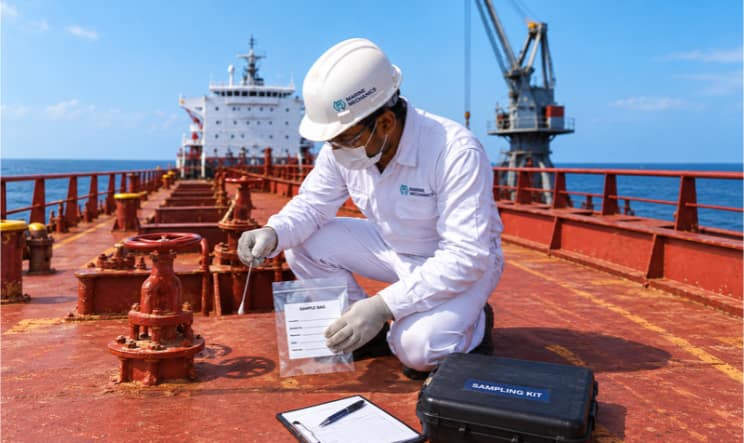
Marine Mechanics uses certified HazMat experts and accredited laboratory analysis for all IHM Part I preparation work. Sampling and survey work is planned around the vessel’s trading schedule and port calls so there is no unnecessary deviation or off-hire.
The team manages the full process from initial scoping and document collection through to supplier declaration chasing, onboard sampling, laboratory analysis, and final certification submission. Rather than managing multiple parties across a complex process, one team handles it end to end.
Keeping the IHM Current: The Marine Mechanics Cloud Platform
The more significant problem for most shipowners is not the initial preparation. It is keeping the IHM accurate and current after certification. Marine Mechanics addresses this through a dedicated cloud platform that treats the IHM as a live document rather than a static file.
The platform maintains a full version history of the IHM, stores Material Declarations and Statements of Compliance against each line item, and sends automated reminders ahead of survey due dates. Shore office teams have fleet-level visibility across all vessels, so compliance status is visible at any point without waiting for a vessel report.
The platform also produces the full document pack a PSC officer asks for: the ICIHM, the EU SRR certificate or Statement of Compliance, the latest Part I revision with its revision number and date, the IHM Maintenance Record, and the screening log with collected declarations. All four download from the portal in under five minutes. The vessel’s crew do not upload certificates or reports. Marine Mechanics experts load all documentation when the ship is enrolled and whenever documents are renewed.
Critically, the platform survives crew changes and superintendent handovers. A spreadsheet stored on one computer does not. When a superintendent leaves or a vessel changes management, the IHM history, documentation, and compliance status are all preserved and accessible.
Managing IHM Compliance Across a Multi-Flag Fleet
For fleet managers operating vessels across multiple Flag States, IHM compliance adds another layer of complexity. Different Flag State authorities interpret the Hong Kong Convention and EU SRR requirements with varying levels of strictness, and survey timelines may differ across jurisdictions.
Marine Mechanics provides fleet-level IHM management through its cloud platform, giving shore office teams a single consolidated view of compliance status, upcoming survey dates, and documentation completeness across all vessels regardless of Flag State or trading area. This removes the dependence on vessel-side record keeping and gives fleet managers the visibility they need to act ahead of a survey rather than react to one.
Frequently Asked Questions
What documents are needed to prepare an IHM Part I?
The core documents required before an IHM survey are the general arrangement plan, machinery arrangement plan, fire protection and insulation plans, IOPP, IAPP, and IAFS certificates, spare parts and tools list, battery log, repair and modification history, and supplier declarations for newer equipment. The surveyor uses these to identify where hazardous materials are likely to be present and to scope the sampling programme. Incomplete documentation at this stage extends the timeline and the cost.
Is laboratory testing required for IHM Part I preparation?
Yes. IHM Part I preparation requires onboard sampling of suspect materials followed by accredited laboratory analysis. Visual inspection alone is not sufficient. Hazardous materials including asbestos, PCBs, heavy metals such as lead, mercury, and cadmium, ozone-depleting substances, PFOS, and HBCDD must be identified by type, location, and quantity through a combination of document review, sampling, and certified laboratory testing. Marine Mechanics uses accredited laboratories for all IHM sampling analysis.
How are hazardous materials identified when vessel documentation is incomplete?
When build documentation is incomplete, which is common on older vessels and ships that have changed hands, the IHM surveyor relies on a combination of visual inspection, sampling of high-risk areas, and cross-referencing with available records. Marine Mechanics certified HazMat experts are experienced in scoping surveys on vessels with partial or missing construction records, prioritising areas with the highest likelihood of hazardous material presence: insulation, gaskets, fire protection materials, older electrical equipment, and anti-fouling coatings.
What should shipowners do when suppliers do not provide Material Declarations?
Supplier declarations are mandatory for new purchases under both the Hong Kong Convention and EU SRR. When suppliers are slow to respond or provide declarations in the wrong format, the IHM maintenance record shows a gap that a PSC officer will query. Marine Mechanics manages the supplier declaration process on behalf of enrolled vessels, chasing outstanding Material Declarations and Statements of Compliance and validating them before logging against the relevant purchase order in the platform. If a supplier cannot or will not provide a declaration, sampling of the item may be required.
How should newly installed equipment be added to an existing IHM?
Any repair, retrofit, or equipment installation that introduces new materials must be logged in the IHM immediately, not held until the next survey. The process is: request Material Declarations and Statements of Compliance from the supplier at the time of purchase, review them for hazardous material content, and update the IHM Part I with the new entry including type, location, and quantity. Marine Mechanics receives notification of purchase orders for enrolled vessels and reviews incoming declarations as part of its ongoing maintenance service. The platform flags items under review and records the outcome against each purchase order.
How can IHM records be managed after a vessel retrofit?
Major retrofits, ballast water treatment systems, scrubbers, new propulsion equipment, and similar installations require a formal IHM revision, not just a note in the maintenance record. The revision should document the materials introduced, their location on board, and the declarations from the equipment manufacturer. Marine Mechanics coordinates IHM revisions following drydocking and major retrofits as part of its maintenance service, ensuring the inventory reflects the vessel as it currently is rather than as it was at the time of initial certification.
What are the consequences of incomplete IHM documentation during an inspection?
Incomplete IHM documentation is treated as a statutory deficiency by Port State Control officers under both the Hong Kong Convention and EU SRR. Depending on severity, deficiencies can range from a written observation requiring follow-up at the next port to detention. The most common deficiencies are a missing or expired certificate, an inventory that shows no evidence of maintenance between surveys, and an inability to produce location plans or supplier declarations when asked. Marine Mechanics recommends that vessels download the full document pack from the portal before every port arrival, not during an inspection.
What to Do Next
If your vessel does not yet have a certified IHM, or if your existing IHM has not been updated since initial certification, the risk is real and growing. Regulatory scrutiny under the Hong Kong Convention and EU SRR is increasing, and the cost of a deficiency finding during a Port State inspection is significantly higher than the cost of keeping the inventory current.
Marine Mechanics is a technical engineering partner for the full vessel lifecycle. Alongside IHM preparation and maintenance, the company delivers navigation and communication services, safety systems, calibration, testing and compliance, Alcovisor, and machinery spare parts across five global locations: India, Singapore, UAE, USA, and China.
To discuss IHM Part I preparation or ongoing maintenance for your fleet, contact the team at mmconsultants@marinemechanics.biz or visit www.marinemechanics.biz.