An inventory of hazardous materials (IHM) is the ship-specific list of hazardous materials in a vessel’s structure and equipment, with their location and approximate quantity. This guide explains what is listed, which ships need one and how the certificate works. It is written for superintendents, technical managers and purchasing teams.
What the Inventory Contains
The inventory has three parts [4].
| Part | Contents | Status |
| Part I | Materials in the ship’s structure and equipment | Maintained throughout the ship’s life |
| Part II | Operationally generated wastes | Completed once a decision to recycle is taken |
| Part III | Stores | Completed once a decision to recycle is taken |
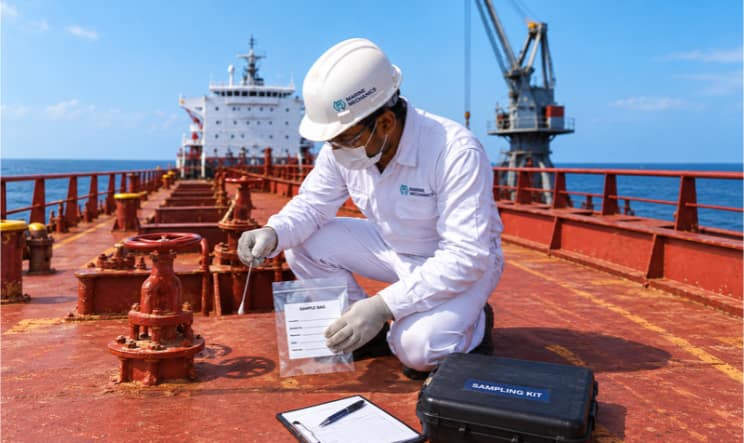
For a trading vessel, maintaining the IHM means maintaining Part I. Each entry names the material, the item containing it, its location on board and the approximate quantity, so a yard or recycler can find it without the crew’s help. The old name, Green Passport, is obsolete.
Table A and Table B Materials
Table A materials are prohibited or restricted and must not be installed or newly supplied. Table B materials may be on board but must be recorded where they exceed the threshold [1].
| Table | Material | Threshold |
| A | Asbestos | 0.1% |
| A | Polychlorinated biphenyls (PCBs) | 50 mg/kg |
| A | Ozone-depleting substances | No threshold |
| A | Anti-fouling systems with organotin | 2,500 mg total tin/kg |
| A | Anti-fouling systems with cybutryne | 1,000 mg/kg (hull, dry paint); 200 mg/kg (wet paint) |
| A | PFOS (EU only) | 10 mg/kg |
| B | Cadmium compounds | 100 mg/kg |
| B | Hexavalent chromium compounds | 1,000 mg/kg |
| B | Lead compounds | 1,000 mg/kg |
| B | Mercury compounds | 1,000 mg/kg |
| B | Polybrominated biphenyls (PBBs) | 50 mg/kg |
| B | Polybrominated diphenyl ethers (PBDEs) | 1,000 mg/kg |
| B | Polychlorinated naphthalenes (Cl ≥ 3) | 50 mg/kg |
| B | Radioactive substances | No threshold |
| B | Short-chain chlorinated paraffins | 1% |
| B | HBCDD (EU only) | 100 mg/kg |
PFOS and HBCDD are EU additions, so a declaration prepared only to the Convention may not cover them. Ask suppliers to declare against the wider EU list. Cybutryne entered the inventory after the anti-fouling controls took effect on 1 January 2023, and MEPC.405(83) clarified how its threshold applies to hull and wet paint samples [2][3].
Which Regime Applies to Your Ship
Both instruments cover ships of 500 GT and above. A ship may fall under one or both [8].
| Your ship | What applies |
| EU or EEA flag, any trade | EU Regulation in full, plus the Convention if the flag is a Party |
| Convention flag, calls at EU or EEA ports | Convention (flag) and EU Regulation (port State) |
| Convention flag, no EU or EEA calls | Convention |
| Non-Party flag, calls at EU or EEA ports | EU Regulation: inventory and certificate still required |
| Non-Party flag, no EU or EEA calls | No direct requirement today, but charterers and insurers increasingly expect one |
Dates That Matter
- 26 June 2030: backstop for existing ships, or earlier if the ship is recycled first [5]. Class societies generally align the initial survey with the first renewal survey in that window, so plan around that survey [10].
Certificates and Surveys
Four surveys run through its life [7]:
- Initial: before the certificate is first issued.
- Renewal: at intervals not exceeding five years. The surveyor examines the maintenance record as well as the inventory.
- Additional: after a change, replacement or significant repair affecting structure, equipment or coatings.
- Final: before the ship is recycled.
Asbestos on Board
SOLAS regulation II-1/3-5 prohibits new installation of asbestos-containing material, without exception since 1 January 2011 [9]. Asbestos is still found on ships certified asbestos-free, often in gaskets, brake linings and cable penetrations, because repairs and spares bring it back. Where it is found on a ship the ban covers, it should be removed within three years, in consultation with the flag State [9].
Common Questions
What is the difference between Table A and Table B?
Table A materials must not be installed or newly supplied. Table B materials may be on board but must be recorded above the threshold, with location and quantity.
How long is an ICIHM valid?
Up to five years. Renewal needs a survey, and the surveyor examines the maintenance record.
Does a ship with a non-Convention flag need an IHM?
If it calls at EU or EEA ports, yes. The EU Regulation requires an inventory and a certificate whatever the flag. With no EU or EEA calls there is no direct requirement today, but charterers and insurers increasingly expect one.
Marine Mechanics is a technical engineering partner for the full vessel lifecycle. IHM is one part of that, alongside testing, compliance, calibration, navigation and communication systems. See IHM Preparation, IHM Maintenance and our IHM Part I guide, or write to mmconsultants@marinemechanics.biz