MARINE MECHANICS · CHINA · INDIA · SINGAPORE · UAE · USA
Sensors on the engine. Analysts on shore. Every second, not every quarter, so the failure that was five months away never happens at all.
Water caught at three and a half times the allowable limit — while the main engine was still running clean.



Every change in machine health appears in the oil before it appears in the machine. Water, fuel, soot, wear metal, the evidence is already circulating, hours before a bearing knows anything is wrong.
A quarterly sample describes one day. The other eighty-nine are a guess. On MV Shahrastani, water saturation stood at twenty-eight per cent on the morning we switched the sensor on. A bottle drawn a fortnight later would have read it as normal.
Sensyn closes that window. The oil is read continuously, on board, and the trend is watched ashore by people whose job is to tell you what it means.
A reading on its own is data. Sensyn closes the loop — from the sensor in the sump to the engineer who knows what to do on Tuesday morning
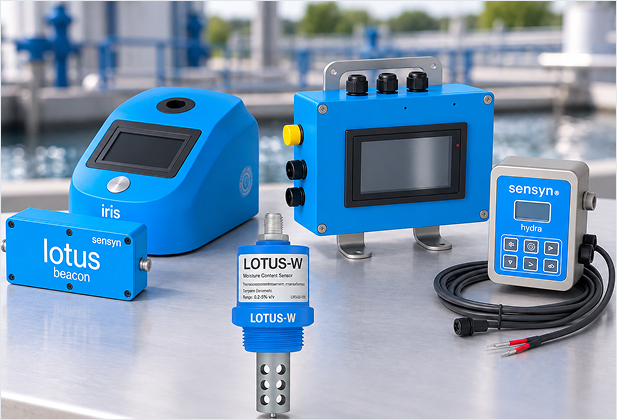
Four instruments, one job: measure the oil in place, at temperature, under load — and report without being asked.
Seven parameters, read continuously on the running engine. No sample jar, no lab, no waiting.
ISO 4406 particle counting on the super-fine filter line, so contamination never reaches your FIVA valves.
Particles down to one micron, sorted into eight size bins and coded automatically. Cleanliness at a glance.
Two millilitres of oil. One second. Lab-grade iron content, on deck, by any crew member on watch.
Every reading from every vessel, in one place. ASTER ranks your machinery by how close it is to trouble, and how long you have.
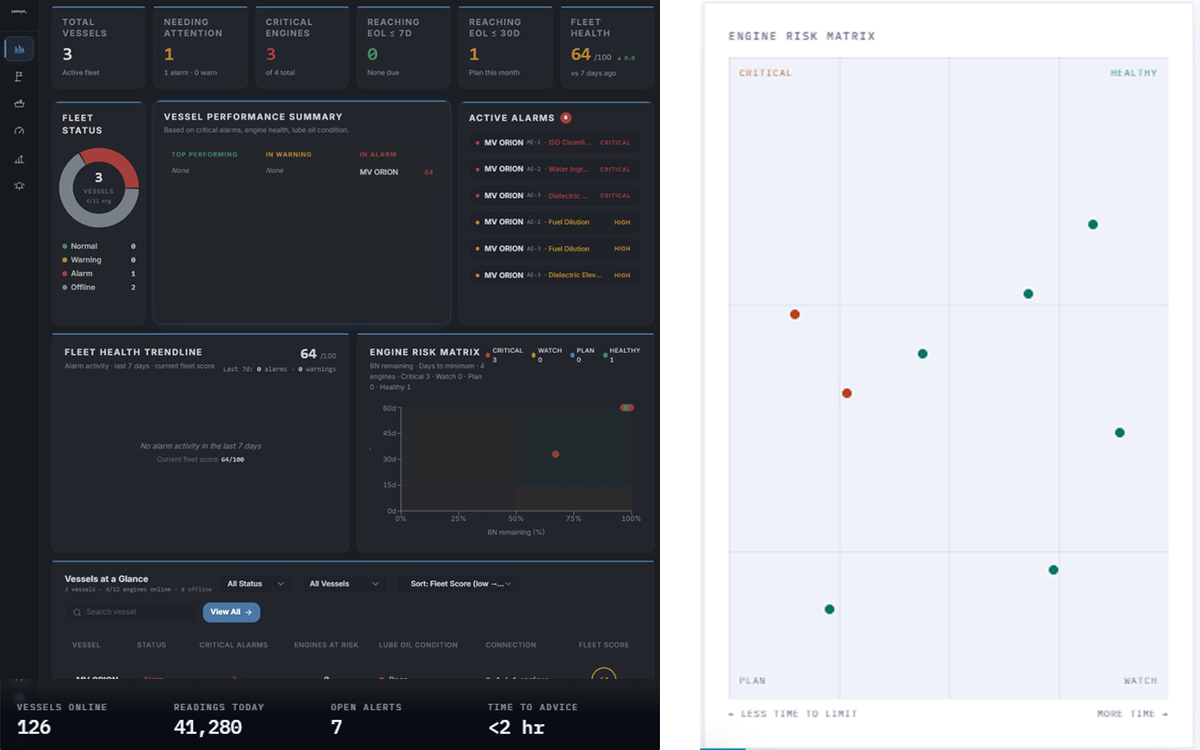
ASTER runs on-premise on the Sensyn PC in your engine control room. Dashboards, alarms and reports work at sea with no satellite link at all. Cloud sync happens when connectivity allows.
Every alert names the vessel, the engine, the fault and the severity — MV Orion · AE-1 · Fuel Dilution · HIGH — and one click takes your chief engineer to the trend behind it.
The fleet view sorts worst-first by default and scores each vessel on alarms, engine health and oil condition together. You act on the vessel that needs you, not the loudest email.
Knowing the oil is wet is half an answer. Orchid pulls the water and the particulate back out — and every litre stays in service.
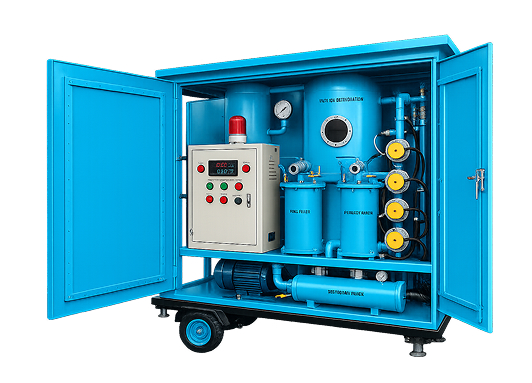
A centrifugal purifier throws away six hundred litres of good oil per engine per year. Orchid throws away nothing — and removes the dissolved water a purifier cannot see at all.
600 LITRES
0 LITRES
Free Only
All three
10–15 µm
5 µm
8–12 h/mo
Annual check
Batch
Continuous
You run the vessel. We watch the oil. Sentinel is a managed service, not a dashboard licence — and our shore team diagnoses the alarm rather than forwarding it.
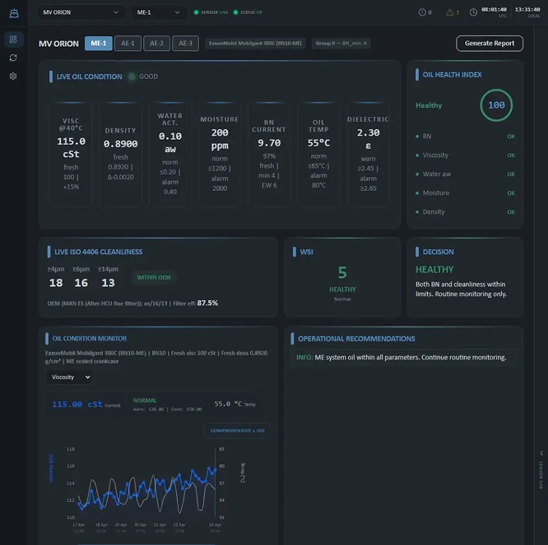
Sentinel is a pure service. Sensyn owns and maintains the sensors, annual recalibration included. If a unit needs replacing, that is our problem.
Four to six hours, no specialist engineers, no drydock. First data visible ashore within twenty-four hours.
A critical alert reaches your shore management by SMS and email, followed by an assessment and a specific recommended action — typically within two hours.
Sixty shore lab samples a year are included, so continuous data sits alongside the periodic analysis your class society expects.
An alert becomes an attendance. Marine Mechanics engineers and genuine spares, five global hubs, twenty-four hours a day.
SUPPORT
Numbers accumulated vessel by vessel, voyage by voyage. Not projected — measured.
Lotus Beacon held an elevated water reading for more than a week — long enough for the Chief Engineer to rule out sampling error and act. Purifiers were overhauled and run in clarifier mode. Viscosity fell 27%, water activity 51%, moisture 42%.
Twenty days of live data on a running LPG carrier already fitted with a shipboard monitoring system. Moisture fell from 1,811 to 663 ppm as purification took hold, with dielectric tracking back toward the fresh-oil value. Wear debris: nil throughout.
A single lab result showing 165 cSt and 1,300 ppm says change the oil now. Eight weeks of trend showed the rise was gradual, density stable, base number healthy — normal ageing. The oil change would have been expensive and unnecessary.
Oil intelligence is not a monitoring cost. It is the cheapest insurance on the most expensive asset you own.
Iris lets you trim the feed rate by 0.1 g/kWh and prove it was safe. On a 15,000 kW two-stroke, that is roughly $41,000 a year.
Orchid on three auxiliary engines: 1,800 litres of oil no longer discharged, plus spares and sump savings. Payback inside 1.2 years.
A single water event caught early. No condemned sump, no disposal, no bearing damage from running on contaminated oil.
A quarter to a third of major lube oil failures trace back to water. One undetected incident runs $200k to over $1M — before off-hire.
Data is only worth what you can do with it. Sensyn brings the intelligence. Marine Mechanics brings the hands, the parts and the port.
Instruments built for the machinery space — vibration, heat, salt and all. Measured inline, at temperature, under load, for years at a time.
Attendance, retrofit and commissioning wherever the vessel happens to be trading. Over a hundred OEM-trained engineers, a thousand service calls a year.
OEM parts stocked near your regular ports and round-the-clock technical support, so an alert turns into a repair rather than a delay.
We will come back with the sensing plan for one vessel, what it would have seen last quarter, and what it costs to cover the fleet.
A thirty-minute call with our condition team
Sensing plan and expected findings, in writing
Pilot on one vessel, then scale the fleet
A dedicated team to support remotely, vessel when is in need. Reduced downtime, faster resolution.
Scheduled servicing turned into planned, budgeted care. No reactive firefighting after a Port State finding.
Certificates, expiry dates and full service history, visible to ship and shore from one secure portal.
Hubs in five countries, genuine spares stocked near your regular ports, delivery on your schedule.
Discover how continuous oil monitoring turns live machine data into early warnings, cleaner oil and clear action.
Explore the sensing technology, ASTER platform, Orchid purification system, Sentinel recommendations and the complete monitoring workflow.
Answers about continuous oil monitoring, onboard installation, machinery health, shore-side analysis and the Sensyn service
Dedicated contacts for every marine service requirement.
NAVCOM SERVICES
SAFETY - LSA/FFA
TESTING & MONITORING SERVICES
CALIBRATION SERVICES
MACHINERY SPARE PARTS
ALCOVISOR
SENSYN